Cheapest Ways to Get All Major Streaming Services in 2026
Get every major streaming service for less. Combine bundles, carrier perks, and deals to access Netflix, Disney+, Max, and Hulu cheaply.
Anúncios
Subscribing to every major streaming service individually costs over $100 per month. With the right combination of bundles, carrier perks, and promotional timing, you can access them all for a fraction of that price.

How Much Does It Cost to Subscribe to Everything Individually?
Anúncios
Netflix Standard costs $15.49, Disney+ $9.99, Max $16.99, Hulu $9.99, Peacock $7.99, Paramount+ $7.99, Apple TV+ $9.99, and Amazon Prime Video $8.99. The total comes to approximately $87 before tax.
Add YouTube Premium at $13.99 and ESPN+ at $10.99 and the bill pushes past $112 monthly. Few households need every service, but even subscribing to the top five costs $60 or more without any optimization.
What Is the Absolute Cheapest Way to Get Everything?
Anúncios
Combine a T-Mobile Go5G Plus plan for free Netflix, Apple TV+, and Hulu. Add the Verizon myPlan Disney+ perk if you have a second line. Use a Chase Sapphire Reserve streaming credit for Max. Buy Paramount+ annually during Black Friday.
With this stack, your out-of-pocket streaming cost drops below $15 monthly for six or more services. The carrier plan costs exist regardless, so the streaming perks are effectively free additions.
Does Choosing Ad-Supported Tiers Make a Big Difference?
Selecting ad-supported tiers across all services saves $30 to $50 monthly compared to ad-free versions. The trade-off is four to six minutes of ads per viewing hour, which most viewers find tolerable.
Netflix with ads costs $6.99 versus $15.49 for Standard. Disney+ with ads is $9.99 versus $16.99 without. Choosing ads on just these two services saves $15.50 monthly or $186 annually.
Which Bundles Offer the Most Services Per Dollar?
- Disney+ / Hulu / ESPN+ bundle — Three services for $16.99/month (best per-service value)
- Spotify Student bundle — Spotify + Hulu + Showtime for $5.99/month
- Netflix + Max bundle — Two premium services for ~$19.99/month
- Apple One Family — Apple Music, TV+, Arcade, iCloud for $22.95/month
- Amazon Prime — Prime Video + shipping + gaming for $14.99/month
How Does the Rotation Strategy Reduce Costs?
Instead of paying for all services every month, subscribe to one or two at a time. Binge everything you want, cancel, and switch to the next pair. Over three months, you cycle through six services at the cost of two.
This approach works best for viewers who watch specific shows rather than browsing casually. Plan your watchlist in advance and align subscription windows with content release schedules for maximum efficiency.
Can You Replace Cable Entirely with Streaming?
Yes, but live TV is the expensive gap to fill. YouTube TV at $73 monthly or Hulu + Live TV at $77 replaces traditional cable channels. Adding on-demand services on top pushes the total to $90 or more.
For cord cutters who do not need live TV, skipping the live component saves the most money. Free services like Pluto TV and Tubi cover casual live-channel browsing without any subscription cost.
What Free Streaming Services Are Worth Using?
Tubi, Pluto TV, Freevee, and the Roku Channel all offer free ad-supported content libraries. The selection skews toward older titles and B-list originals, but the catalogs have grown significantly.
Public library cards also unlock free access to Kanopy and Hoopla, which carry indie films, documentaries, and classic cinema. These services cost nothing and complement paid subscriptions well.
How to Build the Perfect Budget Streaming Stack
Start with free services like Tubi for casual watching. Add one bundle like Disney+/Hulu/ESPN+ for broad coverage. Use a carrier perk for Netflix or Apple TV+. Apply a credit card streaming credit to Max or Peacock.
This approach delivers eight or more services for roughly $17 out of pocket monthly. Rotate Paramount+ in during Black Friday at $1.99 per month and the total barely moves while coverage expands further.
Should You Split Costs with Roommates or Family?
Sharing accounts within a household is legitimate and cuts per-person costs dramatically. A family of four splitting a $17 monthly streaming bill pays $4.25 each for access to multiple services.
Use apps like Splitwise or Venmo to divide shared subscription costs fairly. Assign one person as the account manager for each service to keep logins organized and prevent billing confusion.
What If You Only Want Three or Four Services?
For a focused stack, pick one bundle (Disney trio or Netflix + Max) plus one carrier perk. This covers three to four services for under $20 monthly without needing to rotate or hunt for deals aggressively.
Add a free tier like Peacock free or Tubi for variety. This minimal stack satisfies most viewing needs at a price point competitive with a single premium cable channel.
Monthly Cost Comparison: Optimized vs Unoptimized
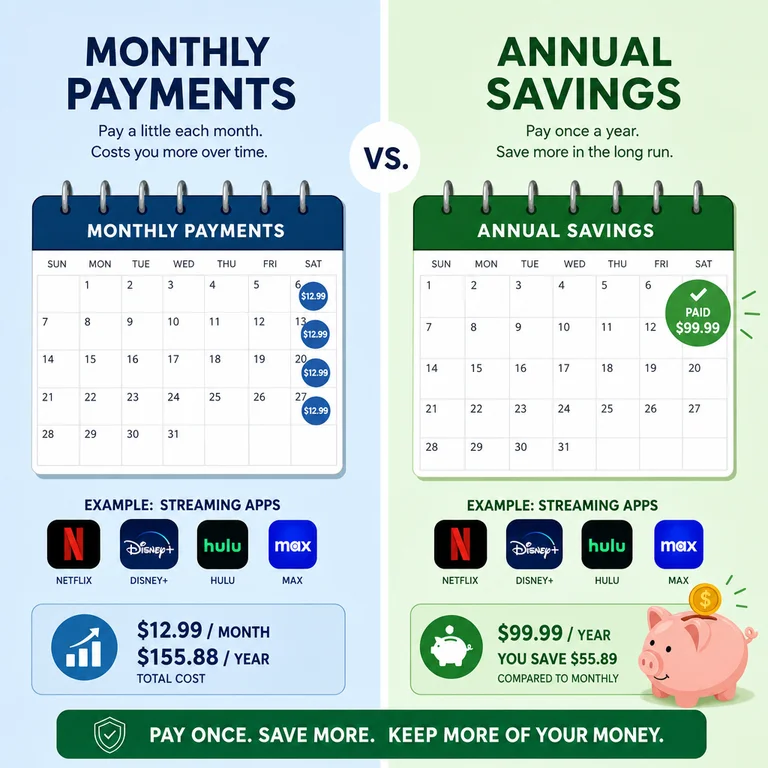
Unoptimized: subscribing to six services individually costs roughly $70 per month. Optimized with bundles, carrier perks, and ad tiers: the same six services cost $15 to $25 monthly. The difference is $540 to $660 annually.
Even partial optimization — choosing one bundle and one carrier perk — saves $20 to $30 monthly. Small adjustments compound into meaningful savings over the course of a year.