How the Spotify Algorithm Works and Recommends Songs
How Spotify algorithm works explained. Discover Weekly, Release Radar, and recommendation system breakdown with tips to improve your suggestions.
Anúncios
Spotify processes billions of data points daily to recommend songs you have never heard but will probably love. The algorithm behind Discover Weekly and Daily Mix uses multiple machine learning models working together simultaneously.
What Technology Powers Spotify Recommendations?
Anúncios
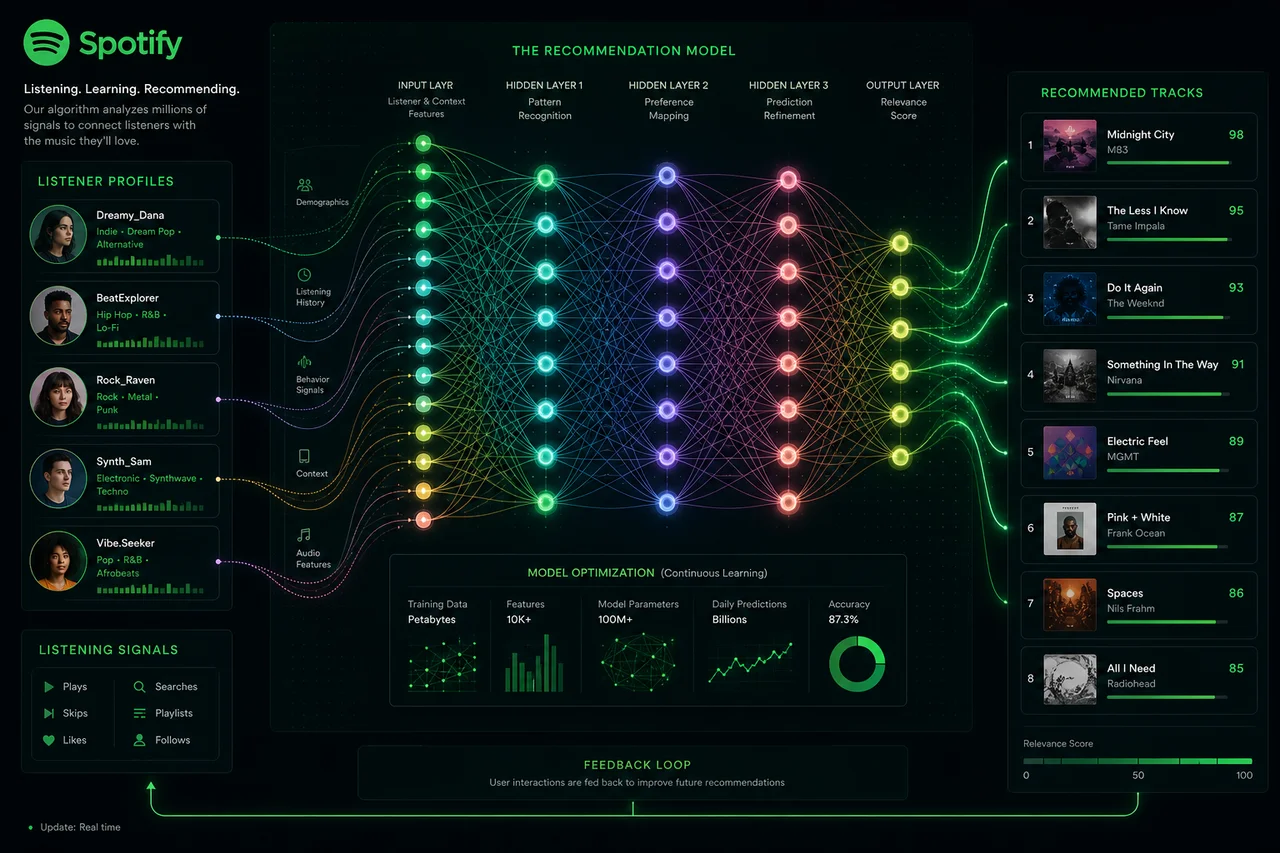
Spotify combines three primary recommendation engines: collaborative filtering, natural language processing, and raw audio analysis. Each engine generates candidate tracks independently, and the system merges results for final suggestions.
Collaborative filtering compares your listening patterns against millions of other users with similar taste. If users who like your favorite artists also enjoy a track you have not heard, the algorithm flags it as a strong recommendation.
How Does Collaborative Filtering Find Similar Listeners?
Anúncios
The system builds a massive matrix mapping every user against every song they have played, saved, or skipped. Matrix factorization techniques compress this data to identify hidden taste patterns connecting users with compatible preferences.
This approach excels at finding non-obvious connections. Two listeners who share 20 favorite tracks probably share a 21st favorite that one has not discovered yet. The algorithm surfaces exactly these missing connections.
What Role Does Natural Language Processing Play?
Spotify crawls music blogs, reviews, social media posts, and news articles to understand how people describe music. NLP models extract genre tags, mood descriptors, and cultural associations from written content about artists and tracks.
This text analysis captures contextual information that pure listening data misses. A blog describing a track as "perfect for rainy Sunday mornings" feeds into Spotify's contextual recommendation engine for mood-based playlists.
How Does Audio Analysis Shape Recommendations?
Spotify runs every track through convolutional neural networks that analyze raw audio waveforms. These models extract features like tempo, key, energy, danceability, valence, and instrumentalness without human input.
Audio analysis particularly helps with new releases and independent artists who lack extensive listening history data. The algorithm can recommend a brand-new song based purely on its sonic similarity to tracks you already enjoy.
What Signals Does Spotify Track From Your Behavior?
- Play count: Tracks played fully signal strong preference
- Skip rate: Songs skipped within seconds signal disinterest
- Save actions: Adding to library marks strong affinity
- Playlist additions: Which playlists you add songs to reveals context
- Repeat listens: Playing a song multiple times boosts its influence
- Time of day: Morning vs evening listening patterns shape contextual suggestions
- Device type: Car, speaker, or headphone listening gets weighted differently
How Is Discover Weekly Generated Each Monday?
Discover Weekly runs a specialized pipeline combining all three recommendation engines. The system identifies 30 tracks you have never played that score highest across collaborative filtering, NLP, and audio feature matching.
The playlist avoids songs from artists you already follow heavily, pushing discovery toward unfamiliar territory. Track ordering is also algorithmic, placing the strongest predicted matches in the first few positions to hook you immediately.
Why Does the Algorithm Sometimes Get Stuck?
Filter bubbles form when you only listen to one genre or set of artists. The algorithm reinforces existing patterns, creating an echo chamber that reduces recommendation diversity over time until you actively break the cycle.
Listening to the same playlist on repeat without exploring new content starves the algorithm of fresh data. It needs varied input signals to calibrate properly and surface genuinely surprising recommendations beyond your comfort zone.
How Can You Train the Algorithm for Better Results?
Actively like songs you enjoy and skip tracks you dislike rather than letting them play passively. Create multiple playlists by mood to give the algorithm clearer signals about your taste dimensions.
Explore genres you are curious about even briefly. A few minutes of jazz or classical listening opens new recommendation pathways. Use the Discover Weekly playlist fully each week to provide maximum feedback data.
What Is the Spotify AI DJ Feature?
The AI DJ uses generative AI to create a personalized radio experience with spoken commentary between songs. It explains why tracks were chosen, shares artist background, and adjusts selections based on real-time listening behavior.
The DJ voice is synthetic but natural-sounding, created using technology from Sonantic which Spotify acquired. It switches between familiar favorites and new discoveries, narrating the transitions like a knowledgeable friend.
How Does Spotify Handle Cold Start Problems?
New users lack listening history for collaborative filtering. Spotify addresses this by asking genre preferences during onboarding and using audio analysis to recommend based on the first few songs played.
New artists face the same cold start challenge in reverse. Without listener data, Spotify relies on audio feature analysis and editorial playlist placement to give emerging music initial exposure to relevant audiences.
Does Spotify's Algorithm Favor Major Label Artists?
Spotify denies pay-for-play in algorithmic recommendations but offers Discovery Mode where artists accept lower royalty rates for boosted placement. This optional tool gives artists algorithmic visibility in exchange for financial concession.
Independent artists can still thrive algorithmically through strong engagement metrics. High save rates, low skip rates, and playlist adds signal quality to the algorithm regardless of label backing or marketing budget.
How Will Spotify Recommendations Evolve?
Spotify invests heavily in multimodal AI that combines audio, text, visual, and behavioral data for richer recommendations. Future systems may incorporate mood detection from voice commands and environmental context from connected devices.
Generative AI will likely create personalized transitions, mashups, and even custom instrumental versions tailored to individual listening contexts. The boundary between curated and generated content will blur significantly.